Spray Foam vs Blown-In Insulation — Which Is Right for Your Pasadena Home?
If you're researching attic insulation options for your Pasadena home, two types come up more than any other — spray foam and blown-in insulation. Both are effective. Both are widely used in Southern California. But they work very differently, perform better in different situations, and come at very different price points.
This guide breaks down exactly how each one works, where each one excels, and how to decide which is the right choice for your specific attic.
What Is Blown-In Insulation?
Blown-in insulation — also called loose-fill — is installed by blowing small particles of material into your attic using specialized equipment. The material fills gaps, corners, and irregular spaces thoroughly, creating a consistent thermal barrier across your entire attic floor.
It's the most common insulation type used in Pasadena and San Gabriel Valley homes — particularly in older properties where attic spaces are irregular and standard batt insulation can't achieve complete coverage.
Two main materials are used for blown-in:
Fiberglass — lightweight, non-combustible, and resistant to moisture. A solid all-around performer for Southern California's climate.
Cellulose — made from recycled paper fiber treated for fire resistance. Denser than fiberglass, excellent at filling irregular spaces, and one of the more eco-friendly insulation options available.
What Is Spray Foam Insulation?
Spray foam is applied as a liquid that expands on contact, hardening into a rigid or semi-rigid material that simultaneously insulates and air seals. Unlike blown-in insulation which sits on your attic floor, spray foam is typically applied to the underside of your roof deck or around specific penetrations and gaps.
There are two types:
Open-cell spray foam — softer and more flexible, with a lower R-value per inch. More affordable and effective for interior applications.
Closed-cell spray foam — denser and more rigid, with a significantly higher R-value per inch. Also acts as a vapor barrier, making it one of the most effective insulation materials available — and one of the most expensive.
How They Compare — Side by Side
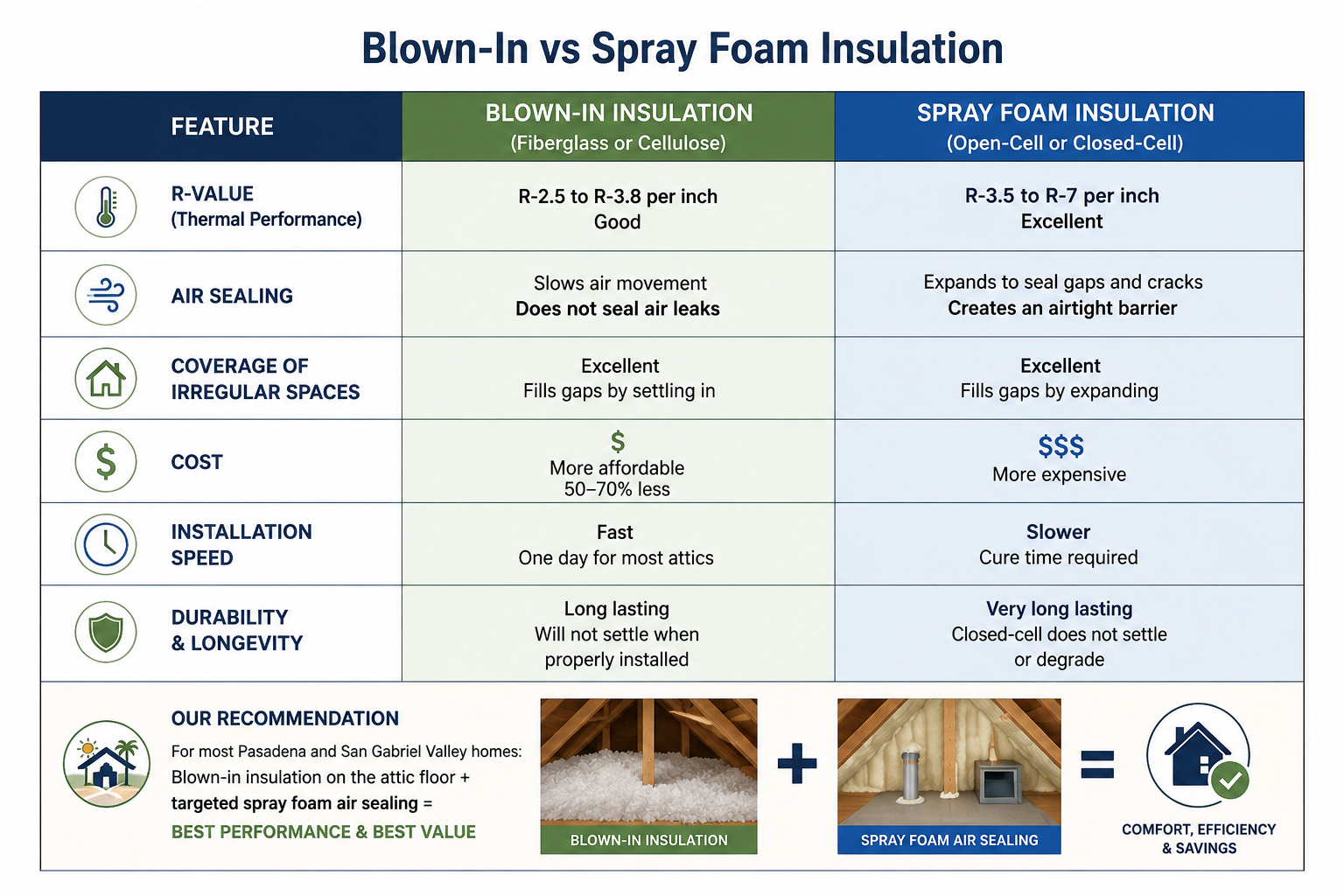
R-Value (thermal performance) Closed-cell spray foam delivers R-6 to R-7 per inch — significantly higher than blown-in fiberglass at R-2.5 to R-3.7 per inch or cellulose at R-3.2 to R-3.8 per inch. If maximum thermal performance in a limited space is the priority, spray foam wins.
Air Sealing This is where spray foam has a clear advantage. Blown-in insulation slows heat transfer but does not seal air leaks. Spray foam expands into every gap and crack, creating an airtight barrier that eliminates the air leakage responsible for a significant portion of energy loss in older Pasadena homes.
Coverage of Irregular Spaces Both handle irregular spaces well — blown-in fills gaps by settling into them, spray foam fills them by expanding into them. Neither requires a perfectly uniform attic to perform effectively.
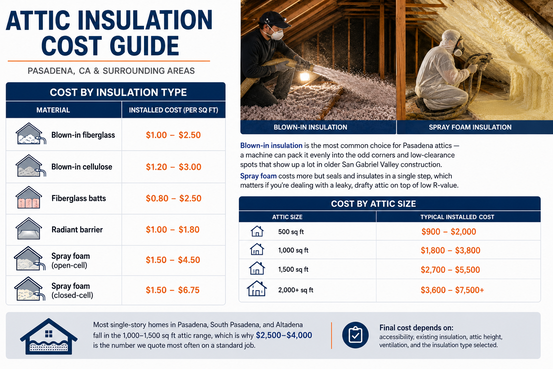
Cost Blown-in insulation is significantly more affordable than spray foam — typically costing 50 to 70 percent less for full attic coverage. For most Pasadena homeowners replacing degraded insulation across an entire attic, blown-in delivers the best value.
Installation Disruption Both are relatively low disruption. Blown-in installation is faster for large attic areas. Spray foam takes longer to cure and requires the space to be unoccupied during application.
Longevity Both materials are long lasting when properly installed. Closed-cell spray foam is particularly durable and does not settle or degrade over time the way older fiberglass batt insulation does.
Which Is Better for Southern California's Climate?
Southern California presents a specific insulation challenge — long, hot summers where heat entering through the roof is the primary problem, combined with mild winters where heat retention matters far less than it does in colder climates.
For most Pasadena and San Gabriel Valley homes, blown-in insulation on the attic floor combined with targeted spray foam air sealing is the most cost-effective solution.
This approach:
- Creates a deep, consistent thermal barrier across the entire attic floor
- Seals the specific gaps and penetrations where air leakage is greatest
- Delivers strong performance at a reasonable total cost
- Works exceptionally well in the older, irregular attic spaces common throughout the area
Pure spray foam across an entire attic makes more sense in new construction or in situations where the attic is being converted to conditioned space — less common in the residential neighborhoods of Pasadena and the surrounding valley.
When to Choose Spray Foam
Spray foam is the right choice when:
- Air leakage is a significant problem and blown-in alone won't address it
- You're insulating a specific problem area — around a chimney, attic hatch, plumbing penetrations, or irregular framing
- You're converting your attic to conditioned living space
- Maximum R-value in a limited depth is required
- You're doing a high-performance energy upgrade and budget is not the primary constraint
When to Choose Blown-In
Blown-in insulation is the right choice when:
- You're replacing degraded or contaminated insulation across an entire attic
- Your attic has irregular framing, obstacles, or uneven joist spacing
- You want strong thermal performance at a cost-effective price point
- You're upgrading an older Pasadena home where complete attic coverage is the priority
- You want a fast, low-disruption installation completed in a single day
What About Combining Both?
For many Pasadena homes — particularly older properties with significant air leakage — the best solution is a combination approach. Spray foam is used to seal specific gaps, penetrations, and problem areas first, then blown-in insulation is installed on top to achieve the target R-value across the full attic floor.
This approach addresses both air sealing and thermal performance in a single project — and delivers results that either material alone typically can't match.
How Do You Know Which Is Right for Your Home?
The honest answer is that it depends on your attic's specific conditions — its age, current insulation, air leakage situation, and your budget. The best way to find out is a free attic inspection where we assess your space, measure your current R-value, identify air leakage points, and give you a clear recommendation with no pressure to move forward until you're ready.
Call Attic Squad Insulation Services at (626) 649-3652 or schedule your free inspection online.
We serve Pasadena, Arcadia, Altadena, San Marino, Monrovia, Temple City, Sierra Madre, and the surrounding San Gabriel Valley.
You might also like